

What is the purpose of the Scale-up scheme, and do we still need it?
The UK's Scale-up Visa, launched in 2022, aims to attract talent to fast-growing businesses by offering a two or three year visa’s to those in qualifying roles who meet specific requirements including the minimum salary threshold, English language and financial requirements. After five years, it would open a pathway to settlement.
The recent announcement about the increase in the minimum salary threshold for a Skilled Worker visa raises questions about the need for potential adjustments to the Scale-up scheme and its continued advantage for individuals and businesses. This article introduces the Scale-up visa scheme and explores its future.
What is Scale-up scheme?
This visa route offers two visa options: a sponsored and an unsponsored. The sponsored visa is available for up to two years, while the unsponsored visa can last up to three years. Applicants must apply for a sponsored visa, which is the starting point for this program.
To qualify for the Scale-up visa, individuals must obtain a valid Certificate of Sponsorship from an approved, UK-based Scale-up sponsor for a role that meets the required skill level with a minimum annual salary of £34,600. In addition, applicants must prove their English proficiency to at least the CEFR Level B1 (equivalent to IELTS 4.0) and meet the financial requirement. After six months of employment for the sponsor, Scale-up visa holders can switch to a different employer without needing another sponsorship or having to notify the Home Office.
The unsponsored scale-up visa route requirements are identical to the initial sponsored visa. Still, the only difference is that the applicant must have completed a minimum six-month period with their sponsored employer, provided they continue to earn a minimum yearly salary of £34,600 or £33,000 for those whose Certificate of Sponsorship was issued before 11 April 2023. This setup offers a straightforward and adaptable path for skilled individuals pursuing work opportunities in the UK.
Partners and children can accompany the applicant on the visa by meeting specific criteria such as the relationship, age, and financial requirements. This flexibility benefit is advantageous for employees relocating with their families. The visa scheme’s primary advantage is keeping families together, allowing dependent partners to work except as professional sportspersons and there is no specific minimum salary threshold for them to fulfil. When lead applicants switch or extend their visa, their partner or their child's status remains unchanged. However, the partner or child must apply for an extension or visa switch simultaneously with or before the lead applicant's visa expiration.
Those aiming to settle must accumulate a continuous five-year period in the UK, adhering to the pathway toward indefinite leave to remain. During this period, they must fulfil the earnings requirement to be eligible for settlement.
A Scale-up Sponsorship License and the burdens
To be eligible to become a Scale-up sponsor, a company can apply through either of the two available pathways: standard or endorsement. To qualify under the standard path, the employer must have grown by an average of 20% over three years in either employment or total sales and have at least ten employees at the start of the three-year period. The endorsing pathway is for companies with an HMRC history of fewer than three years that cannot provide the evidence required in the standard path. To qualify, the company must pay an additional fee to obtain an endorsement from the Home Office-approved endorsing body, which must be obtained within three months from the date of application. There are seven requirements to be satisfied, including demonstrating the potential growth rate required for the Scale-up standard and being expected to meet the definition of a Scale-up in the next four years. In addition to these seven mandatory requirements, employers must also satisfy at least three out of five additional requirements to receive the Sponsorship License.
Does the scheme work so far?
Despite the seemingly straightforward way of obtaining the Sponsorship License, the Scale-up visa scheme presents significant challenges to businesses, including the financial and administrative burden, compounded by the need for more assurance that employees will remain in their posts beyond the initial six-month period. Given that this scheme's principal benefit is attracting highly skilled workers, as of 22nd February 2024 there were only 52 out of over 103,000 Sponsors who were successfully licensed under the Scale-up Scheme since its launch in 2022. This raises the most obvious concern over the attractiveness of this visa route. Or, perhaps, this visa route has been overlooked?
Those businesses that are aware of this sponsorship option undoubtedly will weigh up whether it is worth investing their time and resources, especially when there are other ways to hire a foreign workforce. Another important aspect is that unlike other sponsored work routes, the Scale-up License cannot be renewed beyond the initial four-year period. This aspect further underscores the potential limitations of the Scale-up scheme as a long-term solution for businesses aiming to attract and retain skilled talent. This situation prompts a broader reflection on the necessity of this scheme.
Do we need a Scale-up scheme?
Since its introduction, the Scale-up visa scheme has received minimal attention. According to Sponsored work visas by occupation and industry data, from Q1 to Q3 2023, there were 237,284 applicants for sponsored worker visas. However, only 26 applied for the Scale-up visa, with 20 receiving approvals. In comparison, 174,646 applied for the skilled worker visa and 163,386 were granted.
Before the Home Office introduced the increase in the minimum salary threshold, the Skilled Worker visa route was more appealing due to the lower salary requirement than the Scale-up visa. With the increase, the salary requirement for both visa routes are similar, potentially enhancing the Scale-up visa's appeal due to its added flexibility. However, the future of the Scale-up visa remains to be determined, depending on whether the Home Office decides to revise the threshold further. If the Home Office opts for another increase, it could significantly impact the scheme's demand, casting doubt on the advantages the Scale-up visa offers to attract more applicants, especially considering the already low figures for individual and business applications.
How Our law firm can help
Our team of immigration experts is dedicated to offering comprehensive legal advice and support designed to make your immigration journey as seamless as possible. We pride ourselves in providing personalised assistance tailored to each client's specific needs and circumstances, ensuring a higher likelihood of successful application success.
This article is provided for general information only. It is not intended to be and cannot be relied upon as legal advice or otherwise. If you would like to discuss any of the matters covered in this article, please contact us using the contact form or email us at reception@cnsolicitors.com

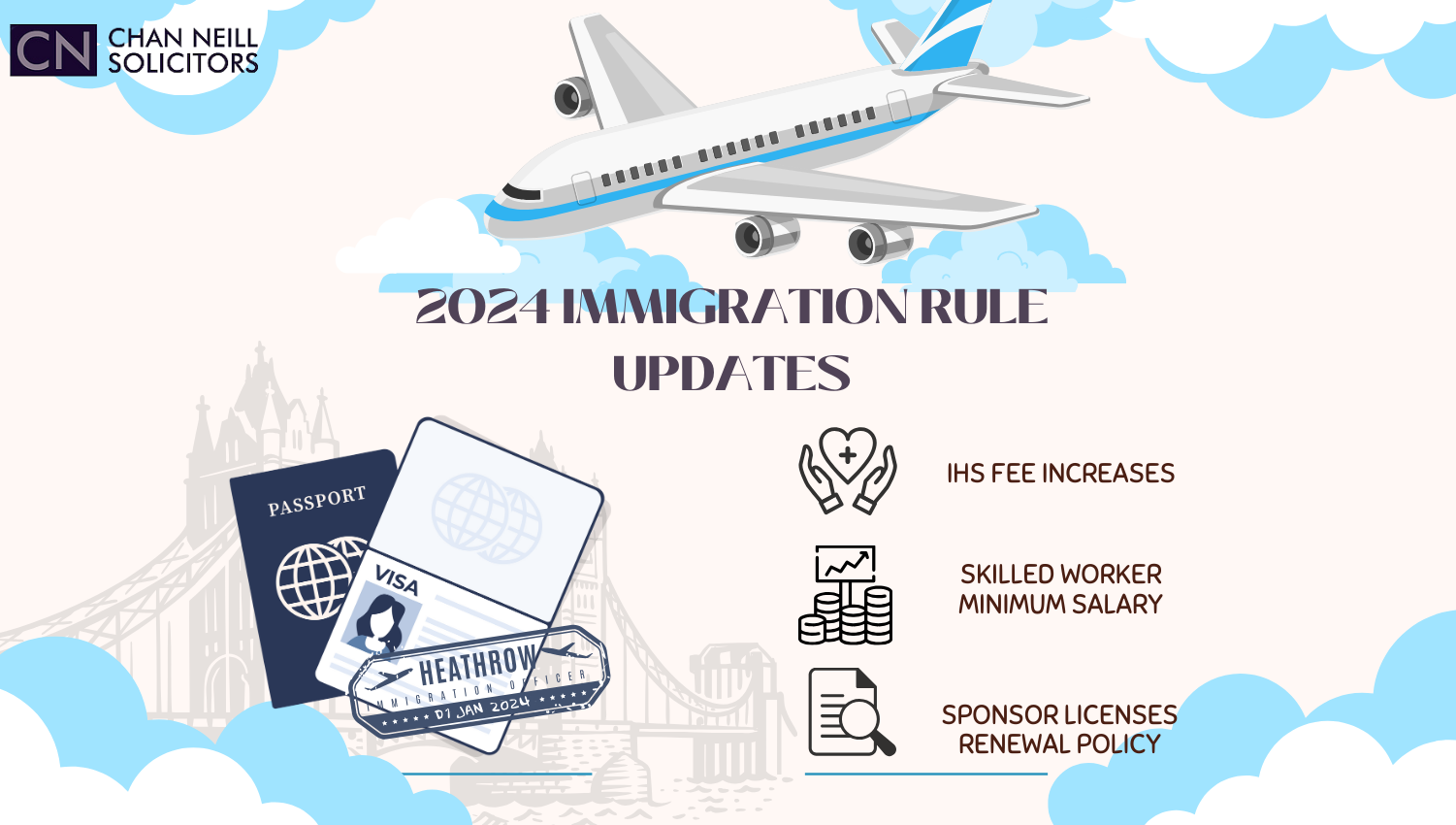
2024 Immigration rule updates
Recently, the United Kingdom has implemented significant changes in its immigration policies, impacting both businesses and individuals. Notable revisions include:
- The Immigration Health Surcharge (IHS).
- Skilled worker minimum salary threshold.
- Spouse, Partner visas (Appendix FM) minimum income threshold.
- The renewal policy for business sponsor licenses.
These changes have introduced considerable financial challenges and administrative shifts for those planning to work, study, or reunite with family in the UK. This article explores these critical immigration developments and their multifaceted effects on immigration processes, recruitment strategies, and administrative burdens.
The Immigrant Health Surcharge Rise
The UK government's recent revision of the Immigration Health Surcharge (IHS), effective from 6th February 2024, presents substantial financial challenges for businesses and individuals. The IHS has seen a significant increase, rising from £624 to £1035 annually and an increase from £470 to £776 for children under 18, students and their dependents. This policy change aligns to make a sufficient financial contribution' reflecting the government's commitment to addressing the impact of migration on the NHS.
The IHS is a mandatory fee for those intending to stay in the UK for over six months. While incremental increases in the IHS have occurred since 2019, this recent rise poses a significant financial challenge for businesses reliant on international talent, potentially effecting their ability to attract and retain skilled overseas workers. Companies may need to reassess compensation and benefits packages, revise recruitment budgets, and consider the overall impact on organisational costs. Similarly, individuals, especially skilled workers, and international students, must engage in careful financial planning as the higher IHS fee adds to the overall cost of obtaining a UK visa. This change may discourage some from choosing the UK as their destination for work or study, potentially reducing the available recruitment pool.
Skilled worker minimum salary threshold.
The recent changes in the skilled worker minimum salary threshold announced on 4th December have far-reaching implications. This nearly 50% rise from £26,200 to £38,700 will come into force from 4th April and could lead to reassessing hiring strategies, particularly for sectors heavily reliant on low-paid skilled migrants. The policy will significantly impact the recruitment pool as it becomes more difficult for immigrants to apply for visas and meet the minimum threshold in the UK. While intending to attract highly paid skilled workers, it may also necessitate a review of hiring strategies in sectors dependent on low-paid skilled migrants.
These changes also impact the Graduate Visa route, vital for international students seeking employment in the UK. While the Graduate Route offers opportunities, the new immigration rules and the raised minimum salary threshold may influence career decisions, potentially affecting sectors traditionally employing international graduates. Moreover, when coupled with increased visa application fees and health surcharges, these policy changes create additional hurdles for individuals pursuing work and education in the UK.
Spouse, Partner visas (Appendix FM) minimum income threshold.
Additionally, aiming to reduce net migration, the Home Secretary has announced a gradual increase in the minimum income requirement for Spouse and Partner visas. Starting 11th April, the threshold will increase from £18,600 to £29,000, eventually reaching £38,700 by early 2025. Family visas are crucial for individuals seeking to reunite with their family members, partners, or spouses in the UK. Anyone wishing to bring their family to the UK must consider applying for a visa before the new requirements take effect in April.
The renewal policy for business sponsor licenses.
On the other hand, a significant change in the UK's immigration law regarding business sponsor licenses takes effect from 6th April 2024. This change automatically extends all sponsor licenses set to expire after this date by ten years, eliminating the need for renewal and associated fees. Nevertheless, sponsors with licenses expiring before 6th April 2024 still need to apply for renewal and pay the associated costs to remain licensed. Failure to renew could lead to employment restrictions for sponsored employees. The new policy removes the need for renewal every four years, reducing administrative efforts and costs burdened on businesses.
This change is a significant relief for businesses employing foreign workers. Eliminating renewal requirements means cost savings and less time spent on administrative processes. Businesses can focus more on strategic talent acquisition and management without worrying about sponsor license renewals. With these changes, companies must understand their new responsibilities and opportunities. The extension of the sponsor license validity period marks a positive shift for firms in the UK, simplifying the process of employing foreign talent and providing more stability and predictability.
Given these significant changes, our law firm extends its expertise in providing legal advice and support to navigate the evolving immigration landscape. We assist businesses in understanding and complying with new regulations, optimising recruitment strategies and addressing legal challenges. We also guide individuals, particularly skilled workers and international students in navigating visa applications and career planning amidst these transformative shifts. Our firm ensures that businesses and individuals can thrive in this changing immigration environment.
This article is provided for general information only. It is not intended to be and cannot be relied upon as legal advice or otherwise. If you would like to discuss any of the matters covered in this article, please contact us using the contact form or email us at reception@cnsolicitors.com
Understanding the Returning Resident Visa: Requirements, Eligibility, and Application Process
Returning Resident visa caters to those who previously had indefinite leave to remain in the United Kingdom (also known as “settlement”) which has now lapsed, and who now want to return to and settle in the UK.
If the visa application is successful, having been granted permission to re-enter the UK, the applicant's residential rights and benefits will be restored.
The Returning Resident visa application must be submitted from outside of the UK and the following validity requirements must be met:
- The application must be submitted on the ‘UKA/ROA/RR’ form or (for applicants under the Windrush Scheme) the ‘Windrush Scheme application (Overseas) form
- The applicant must be outside the UK
- The required fees must be paid (no fee is required for the Windrush Scheme)
- The required biometrics must be provided
- The applicant’s identity and nationality must be established
- There must be a record of the applicant being previously granted settlement in the UK, which has now lapsed due to the absence
On the application, the genuine intention to settle in the UK must be demonstrated as well as strong ties to the country through family, assets or business connections. Furthermore, the length of time the applicant had lived in the UK before their departure will also be a factor in considering whether there is a strong link. As such, the longer the period of residence in the UK was, the more reason will be to believe that the applicant has established a strong connection with the UK.
Important to note that when assessing an application, the Home Office will also take into consideration the reason for the prolonged absence, would it be medical treatment, caring for a family member, overseas employment/self-employment or studies. Overstaying due to inability to travel can also be taken into consideration.
Lastly, some applicants might be subject to a TB test requirement.
The application fee is currently set at £637. The current processing time is 3 weeks. If the application is successful, the passport will be endorsed with an entry clearance vignette valid for 3 months. The BRP card will be available for collection at a designated post office upon arrival in the UK.
At Chan Neill Solicitors LLP we have an experienced immigration team which has been successfully assisting applicants with a Returning Resident visa for many years. Do not hesitate to contact us for advice and assistance.
How will new immigration rules affect international students and their families studying in the UK?
On 17th July 2023, the Home Office made some changes to immigration rules, the most significant of which is the restriction on overseas students bringing family members to the UK.
However, when the news was released in May, the Home Office announced the scheme expected to be implemented in January next year.
Unexpectedly, yesterday's Immigration Rules Update document announced without warning that the restriction on overseas students bringing family members had begun.
Today's post will focus on how this update to the immigration rules will affect overseas students.
Restrictions on student visa holders bringing family members to the UK.
The UK is home to several world-renowned institutions of higher education. Hence, so many international students from all over the world come to the UK every year to further their studies.
Students of all ages come to the UK for higher education, with many returning to study after starting a family. To allow students to combine family life with study, the UK government has previously allowed holders of long-term student visas to bring their spouses and children to the UK.
Whilst student visa holders are subject to restrictions on working hours and other business activities, their spouses are free to work and do business in the UK whilst on a Dependent visa. As a result, more and more people are using the combination of a student visa and a Dependent visa as a transition for the whole family to immigrate to the UK, which has led to the student visa being gradually abused and losing its original purpose.
This immigration rule update is also the result of the UK government's desire to stop the abuse of student visas and return them to their original purpose of serving academic research.
Overall, the Home Office has not applied a blanket rule on overseas students bringing family members with them. Instead, they have increased the requirements for overseas students who can bring family members with them, depending on the circumstances.
Currently (after 17th July) there are specific conditions for students to be able to bring their families to the UK:
- Government Scholarship students studying a programme of 6 months or more
- Full-time students studying a postgraduate or above programme (RQF level 7 or above) of 9 months or more.
Please note that the requirements will remain in effect until the end of this year, except for government scholarship students who will not be affected. Additionally, restrictions for students pursuing postgraduate or higher-level courses will be further strengthened starting from 1 January, 2024.
Only the following two types of postgraduate or above courses commencing after 1/1/2024 will be allowed to bring dependents:
- PHD doctoral degree or other doctoral degree (RQF level 8)
- Research-based Higher Degree (RQF 8)
This update to the immigration rules is only for upcoming dependents of students, and applications for dependents of students submitted before 17 July will be reviewed under the previous rules.
Pathway requirements added for a student visa to other work/business visas. Some new prerequisites for student visas to be converted to other work/business visas have been added to the Immigration Rules Update published on the 17th.
The work/business visas affected are:
- Skilled worker visas
- Visas within the Global Business Mobility Programme
- Tier 2 Minister of Religion Visa
- Overseas Chief Representative Visa
- British Ancestor Visa
- Global Talent Visa
- High Potential Talent Visa
- Expansion Worker Scale-up Visa
- Innovation Founder Visa
- International Athlete Visa
- Various short-term work visas, etc.
There were no special requirements in the previous immigration rules for converting a student visa to another work/business visa. If the student found a company with employer sponsorship qualification that is willing to sponsor him/her for the corresponding work visa or fulfilled the eligibility criteria for a particular business visa, then the student could convert to the corresponding visa at any time during his/her student visa.
However, with effect from yesterday (17 July), one of the following conditions must be met to be able to convert from a student visa to a work/business visa:
(a)The applicant must have completed the course of study for which the Confirmation of Acceptance for Studies was assigned (or a course to which ST 27.3 of Appendix Student applies); or
(b) Condition B:
(i) The applicant must be studying a full-time course of study at degree level or above with a higher education provider which has a track record of compliance; and
(c) Condition C:
(i) The applicant must be studying a full-time course of study leading to the award of a PhD with higher education provider which has a track record of compliance.
(ii) The Certificate of Sponsorship in SW 1.2(d) must have a start date no earlier than 24 months after the start date of that course.''.
The requirements for Global Talent Visa, High Potential Talent Visa and Innovative Founder Visa are more stringent, and only applicants who fulfil point 1 or 3 of the above conditions can complete the conversion from student visa to these 3 types of visas.
These are the highlights of this immigration rule update on the overseas student community. There is no restriction on international students to stay in the UK after graduation. If they cannot immediately convert from a student visa to a work or business visa, they can still obtain a two-year stay on a Graduate Visa and look for work opportunities in the UK. These measures are to prevent the misuse of student visas, work, or business visas, and to regulate the influx of immigrants to the UK. Additionally, they aim to enhance the overall quality of immigration.
Students undertaking advanced academic education and research in the UK will still be able to enjoy the right to bring their dependents with them, and the threshold between student and work/business visas will go some way to improving the quality of professional or business immigration.
Under the current criteria, if you wish to save time by completing a seamless transition from a student visa to a work or business visa to achieve permanent residence, we recommend you start your immigration pathway planning as early as possible.
The professional immigration team at Chan Neill Solicitors can provide you with the most suitable immigration solution based on your background. If you require any assistance, kindly reach out to us.
Permanent residence policy changes; stopping certification of tech talent
Today we will look at the changes to other immigration categories in the Immigration Rule Changes Statement
The requirement for continuous residence of 10 years has been revised to exclude short-term stays on visas from being counted towards achieving permanent residency
People who have been legally resident in the UK for 10 years, also known as 'Long Residence', are eligible to apply for Indefinite Leave to Remain, also known as UK Permanent Residence or UK Green Card.
Ten years of continuous lawful residence means the applicant has resided in the UK uninterruptedly for the last ten years on an authorized visa. Applicants may hold a combination of different types of Visas of varying lengths of time, including student visas, business visas and various short-term visitor visas.
However, this Immigration Rule Change Statement removes the eligibility of various short-term visas and some residence situations to count towards ten-year permanent residence.
The specific types and circumstances of the disqualified visas are as follows:
- Short-term Tourist Visitor Visa
- Short-term (English) Study Visitor Visa
- Seasonal Temporary Worker Visa
- EA stay during the corona outbreak
- Staying during Immigration Bail
Immigration Bail is a procedure used when a person is at risk of imprisonment because of their immigration status, mainly for visa overstays or asylum seekers whose appeal rights have been exhausted.
It means after 13 April, ten years of permanent residence with any of the above residence conditions will have to be recalculated.
Contact us immediately so we can help you prepare your documents and submit your application as soon as possible before the new policy comes into effect if you are in any of these situations and are about to meet the 10-year permanent residence requirement.
The Tech Nation will cease operation, and the list of certified agencies for the global talent visa has updated
In the previous article, we mentioned that the immigration department addressed the list of sponsors for the Innovator Founder Visa. This change will also apply to The Global Talent Visa.
As a Visa category for the admission of high-caliber talent, the Global Talent Visa requires very professional qualifications from applicants.
To be eligible for this Visa, applicants need to have a proven track record of winning prestigious awards in the industry or an endorsement from a professional accreditation body in their field.
The list of accredited sponsors that can approve endorsements to Global Talent Visa applicants after 13 April 2023 will also have an update.
The certification body has announced new changes in tech Nation, a technology certification body for digital technology (fintech, gaming, cybersecurity, artificial intelligence) talent.
In January 2023, the UK media reported the Tech Nation had lost its government funding, leading to Tech Nation ceasing operations on 31 March 2023.
Tech Nation is a government -funded organization dedicated to facilitating the scaling of the UK tech ecosystem. Over the past decade, Tech Nation has helped grow and scale over 5000 startups, including Revolut, Monzo, Ocado, Skyscanner, Delivery and many more.
Tech nation is also one of the certifying bodies for the Global Talent Visa, certifying and helping the UK government bring in hundreds of talented individuals in the digital technology sector.
The new immigration rule change statement does not specify how the immigration Service will process applications for Global Talent Visas that have been or will be certified by Tech Nation.
However, Tech Nation has confirmed that they will continue to process applications already submitted for certification as usual after 31 March in the absence of a published alternative accreditation.
Chan Neill Solicitors can advise digital technology talent applicants of the visa pathways that are still available and find alternatives on a client-by-client basis. If you have any questions, contact our immigration team.
Border Force Seizures
On occasion, packages are seized by either HMRC or Border Force when bring imported or exported across the UK border. This can occur for a variety of reasons. (i.e. the wrong tax or duties being paid, incorrect or missing paperwork such as licences-, prohibited items being included in the shipment, suspicion that the items in question may be the proceeds of crime).
Border Force officer may stop you when you pass through the green channel at airport. They are entitled to carry out baggage checks in front of you. You must declare to customs if you bring:
- Anything over your duty-free allowance
- Banned or restricted goods in the UK
- Goods that you plan to sell
- More than £10,000.00 (or its equivalent) in cash, if you are coming from outside the EU
Notice of Seizure of Goods
If you receive a Notice of Seizure of Goods from the Border Force, this means that items that you have tried to import or export haver been confiscated by the body in question. The communication will include the contact details of whichever organisation currently has your belongings in their possession, and will inform you of what to do next if your package has been seized by customs.
Border Force Restoration Policy
The Border Force restoration policy is a set of rules, stating that if Border Force has seized goods that belong to you, you can apply to have those item restored. You will need to submit a Restoration Request or Notice of Claim in 30 days after the seizures.
Border Force will consider all requests for the return of seized items, and will take into account all information that you provide to support your claim. However, if the items they have confiscated are prohibited or related to any crime – including tax evasion or smuggling – it is highly unlikely that they will be returned.
If you receive a Border Force warning letter (Notice 12A), the best first step is to seek legal advice. You should then contact the authority that currently holds your items as soon as possible, as Border Force expect to receive a Restoration Request or a Notice of Claim within a month.
Border Force usually start destroying perishable items such as alcohol and tobacco products after 45 days, so it is important to ensure that your claim is sent well before this time.
Border Force and HMRC
Border Force may pass your matter to HMRC if there is reasonable suspicion that is proceeds of crime related.
To request the return of seized items from HMRC, you will have to appeal a confiscation and request the return of seized items. HMRC and Border Force will consider all requests of this kind, However, if the items are found to be the proceeds of crime and/or are illegal to own in the UK, it is highly unlikely that they will be returned to you.
Conclusion
If HMRC or Border Force seized your goods, we can provide legal support by helping you to write as notice of claim or a restoration letter. We can also represent you if you decide to make a claim for unfair treatment by the Border Force officers, and/or if your HMRC seized goods are being treated as evidence of a crime.
Under these circumstances, a case may be taken to court claiming that the goods should not have been seized in the first place, and, if successful, you might be eligible for compensation. We have experience in helping clients dealing with Boarder force and HMRC, if you have any inquiry please contact us.
Immigration Case Studies
Sponsor licence granted for small-sized company in 10 working days.
Background of the case: The company is a small-sized education consulting company with only two full time employees. The company has been established for a long time and it is a stable and mature business. The business operation is relevantly small, and the company’s turnover is low (below the VAT threshold).
Chan Neill Solicitors assisted the company with accumulating the following information and documents to prove the stability of the company's business: business model, business profile and various business activities. In addition to explaining why the company needs overseas employees for its business and justify the necessity of applying for a sponsorship licence.
Based on the client’s needs, expedited service was successfully approved (this service is limited to 10 applications per day) and the company was granted a licensed sponsor under the Skilled Worker Route in 10 working days.
Recently the UK has introduced Global Business Mobility routes and High Potential Talent visas to attract overseas talent. To retain these talents, UK companies are still required to have a valid sponsor licence to provide workers with a work visa.
Tourist visa switched to Dependant visa in 2 working days
Background of the case: Mr Z and his spouse entered the UK as tourists in 2021. Due to the Covid restrictions, Mr Z could not return to his country. We assisted him in applying for an Exceptional Assurance (EA) extension before he must return to his country. An approved confirmation of EA was received with the validity date until July 2022 for Mr Z. In the meantime, we waited for his spouse to switch to a Skilled Worker visa to be granted as she was offered a position in the UK. After his spouse’s Skilled Worker visa was approved, Chan Neill Solicitors began to assist Mr Z’s to prepare for his Dependant as a Partner visa application.
Under the regulations and guidance from the Home Office, applicants are required to provide proof of address with their spouse for a period of two years as evidence that they living together. Mr Z were not able to provide the relevant documents for the past two years due to the following reasons first of all, they have not lived together for a long period of time, secondly previous accommodation documentations were not kept, lastly, they both entered the UK for a short period of time.
Since Mr Z were not able to fulfil the requirement of providing proof of address for the past two years. Alternatively, Chan Neill Solicitors advised Mr Z to compile the recent hotel reservations, travel confirmations and photos to be used as evidence showing they are living together and explained the reasons for Mr Z to apply for switch to a Dependant as a partner visa within the UK on the grounds of international travel restrictions. Mr Z attended his UK visa interview on a Friday and received the visa issuance email in two working days.
Typically, spouse visa or dependent visa applications requires several documentations as proof of relationship. Chan Neill Solicitors are able to advise and assist client’s based on their situation.
Our immigration advisors are focused on problem solving and are highly experienced in dealing with complex immigration issues. If you have any queries regarding immigration and/or visa, please contact us.
Tourist Visa change to Skilled Worker visa
Background of the case: The applicant entered the UK as a tourist in 2021. Due to the Covid restrictions, she could not return to her country. We assisted her in applying for an Exceptional Assurance (EA) extension before she must return to her country. An approved confirmation of EA was received with the validity date until May 2022.
The applicant was offered a position in the UK whilst she was waiting for her EA.
Under the regulations and guidance from the Home Office , anyone comes to the UK as a visitor, one can not switch visitor’s visa to a Skilled Worker Visa within the UK. The applicant must return to his or her original country to apply for a Skilled Worker Visa. If our applicant has returned to her original country, she would not be able to work for three to four months, however, her future employer wouldn’t be able to hold up the position for three to four months.
Chan Neill Solicitors assisted the applicant in booking English tests with different exam providers and got the English test results much faster than normal.
Whilst the applicant was preparing for the exams and waiting for the results, Chan Neill Solicitors completed the Sponsor’s Licence application for the employer, as well as prepared the client’s documents for the Skilled Worker Visa. In the application, we provided supporting documents showing the reasons that the applicant needed to switch tourist visa to the Skilled Worker Visa in the UK.
The Skilled Work visa application was submitted on 14th March and a super priority service for the applicant was selected (although the priority and super priority visa service were temporarily suspended by the Home Office during the time). The application was approved within three hours after the biometric information was collected on 22nd March.
We subsequently applied for the applicant's family dependant visa. The applicant's spouse and child got their visas in one week.
Chan Neill Solicitors believe every client, be they a multi-national corporate or a private individual, deserves faultless service standards. At Chan Neill Solicitors LLP, we understand the nuances of Asian and Middle Eastern cultures well. Across our team, we speak many languages including Mandarin and Cantonese, Gujarati, Russian, French, Korean and Spanish. With access to our solicitors at two locations, one in City and one in Mayfair, we cover a very broad spectrum of varying clients needs.
If you have any queries regarding immigration and/or visa, please contact us.
The Global Business Mobility Visa
The Global Business Mobility Visa
The Home Office recently have release new visa category – The Global Business Mobility Visa. The Global Business Mobility Visa is designed for overseas businesses seeking to establish a presence in the UK, or to transfer staff to the UK, for specific business purposes. The Global Business Mobility Route will open to new applicants on 11 April 2022.
The Global Business Mobility visas reformed and expanded on a number of existing business visas including the Representative of an Overseas Business Visa and the two types of Intra-Company Visas. There are five routes:
- UK Expansion Worker Route
- Senior or Specialist Worker Route
- Graduate Trainee Route
- Service Supplier Route
- Secondment Worker Route
The Global Business Mobility Visas will not lead directly to settlement in the UK. However, once in the UK, Global Business Mobility visa holders may be able to switch into other immigration routes that leads to settlement.
UK Expansion Worker Visa Route
The UK Expansion Worker Visa is to replace the Representative of an Overseas Business Visa. The UK Expansion Worker Visa can only be used when the business has not started trading in the UK. If the business is already trading in the UK, workers should apply for the Senior or Specialist Worker Route.
The visa is for overseas senior managers and specialist employees looking to undertake temporary assignments related to the expansion of their businesses in the UK.
UK Expansion Worker Visa applicants need to be currently working outside of the UK for a business that is linked to their UK sponsor group for a cumulative period of at least 12 months, unless they will be working in the UK as a high earner earning at least £73,900 per annual or as a Japanese national seeking to establish a UK branch or subsidiary under the UK-Japan Comprehensive Economic Partnership Agreement.
Applicants will need to have a valid Certificate of Sponsorship for the job they’re proposing to do, issued by an employer that’s authorised by the UK Home Office to sponsor a UK Expansion Worker.
Applicants will also need to have an eligible job at or above an appropriate minimum skill level, with a salary of at least £42,400 per annual or the ‘going rate’ for that job, whichever is higher.
The UK Expansion Worker Visa is not a route to settlement. If successful, permission will be granted for one year at a time, and up to two years in total. Applicants, however, may be able to switch to another route.
Senior or Specialist Worker Visa
Senior or Specialist Worker Visa is to replace the Intra-Company Transfer Visa, it will open on 11 April 2022. The Senior or Specialist Worker Visa is designed for senior managers and specialist employees undertaking a temporary assignment in the UK. The UK company needs to be linked by common ownership to the overseas employing company.
The applicant needs to have worked outside the UK for the linked business for a cumulative period of at least 12 months, unless the applicant is a high earner earning £73,900 or more per year. The Sponsor of the Senior or Specialist Worker Visa must be listed as A-rated company on the Home Office’s register of licensed sponsors. The applicant’s Certificate of Sponsorship (CoS) must have been issued no more than 3 months before the date of the applicant’s Global Business Mobility – Senior or Specialist Worker Visa application.
The job needs to be genuine and the salary needs to be more than £42,400 per year or the “going rate” for the job, whichever is higher.
The applicant needs to have enough funds without relying on public funds for support and have a valid TB certificate if required.
The Senior or Specialist Worker Visa does not lead directly to settlement in the UK. However, applicants may be able to switch into another immigration route which leads to settlement.
Dependent partner and dependent children can apply for this route.
Graduate Trainee Route
Graduate Trainee Route is to replace the Intra-Company Transfer Graduate Trainee Route. The Global Business Mobility – Graduate Trainee Visa is designed for workers on a graduate training course leading to a senior management or specialist position, and are required to do a work placement in the UK. The Graduate Trainee Route will open on 11 April 2022.
The Graduate Trainee Visa Route does not lead directly to settlement in the UK. However, applicants may be able to switch into another immigration route which leads to settlement.
Dependent partner and dependent children can apply for this route.
The applicant needs to have worked outside the UK for a business for at least three months before the date of your visa application. The overseas business and the UK sponsoring company are needed to be linked by common ownership or control, or by a joint venture.
The job sponsoring is genuine and the salary is no less than £23,000 per year or 70% of the “going rate” for the job, whichever is higher.
The applicant needs to have enough funds without relying on public funds for support and have a valid TB certificate if required.
The Sponsor of Graduate Trainee Route must be listed as A-rated company on the Home Office’s register of licensed sponsors. The applicant must have a valid Certificate of Sponsorship (CoS) for the job you are planning to do, and your Certificate of Sponsorship (CoS) must have been issued no more than 3 months before the date of the applicant’s Global Business Mobility – Graduate Trainee Route application.
Service Supplier Route
The Service Supplier route is for contractual service suppliers employed by overseas service providers, or self-employed independent professionals based overseas, looking to undertake temporary assignments in the UK to provide services covered by a UK international trade agreement.
This route is to replace the contractual service supplier and independent professional provisions under the Temporary Work – International Agreement route. The service Supplier Route will open on 11 April 2022.
Service Supplier Visa applicants will need to be currently working as or for an overseas service provider that will provide services to their UK sponsor and have worked as or for the overseas service provider outside the UK for a cumulative period of 12 months.
The applicant must have a valid Certificate of Sponsorship (CoS) for the job they’re proposing to do, issued by an employer that’s authorised by the UK Home Office to sponsor a Service Supplier. The UK sponsor must have a relevant Home Office registered contract with an overseas service provider on which the applicant will work in the UK.
Applicants will not need to satisfy a salary requirement but the job is required at or above a minimum skill level, or applicants have a university degree or equivalent level technical qualification and experience meet the nationality requirement for a Service Supplier.
Applicants need to be a national of the country or territory in which the overseas service provider is based; or where the service that you will provide is covered by a commitment in the General Agreement on Trade in Services and your employer is established in a country or territory that has made a notification under Article XXVIII(k)(ii)(2) of that agreement, a permanent resident of that country or territory; or where the service that you will provide is covered by a commitment in the Temporary Agreement between the Swiss Confederation and the United Kingdom of Great Britain and Northern Ireland on Services Mobility, a permanent resident of Switzerland; or where the service that you will provide is covered by a commitment in the United Kingdom-European Union Trade and Cooperation Agreement, a national of any Member State of the European Union or any other person included in the definition of “natural person of a Party” for the European Union in Article 512(k) of that agreement; or where the service that you will provide is covered by a contractual service supplier commitment in the CARIFORUM-United Kingdom Economic Partnership Agreement, a national of any CARIFORUM State that has provisionally applied or brought into force that agreement.
Permission will be granted for either the time given on the Certificate of Sponsorship plus 14 days, the length of time that will take the applicant to the maximum time period allowed in the category or the maximum single assignment period of either 6 months or 12 months.
Applicants under Global Mobility Visa – Service Supplier Route will be able to extend your stay in the UK up to a maximum period of 5 years in any 6 year period.
The Service Supplier Route does not lead directly to settlement in the UK. However, applicants may be able to switch into another immigration route which leads to settlement.
Dependent partner and dependent children can apply for this route. Access public funds are not permitted.
Secondment Work Route
The Secondment Work Visa is designed for overseas workers who wish to be temporarily seconded to the UK by their overseas employer as part of a high value contract or investment. The Secondment Worker route will open on 11 April 2022.
Applicants need to be currently working for an overseas business that has a contract with UK sponsor which has been registered with the Home Office. The applicants need to have worked outside the UK for that overseas business for a cumulative period of at least 12 months.
The Certificate of Sponsorship (CoS) will need to have been issued by a UK-based business that is authorised by the Home Office to sponsor a Secondment Worker. The UK-based business must be listed as A-rated on the Home Office’s register of licensed sponsors, unless you were last granted permission as a Secondment Worker and are applying to continue working for the same sponsor as in your last permission.
The job needs to be genuine and at an appropriate skill level. The applicant needs to have enough funds without relying on public funds for support and have a valid TB certificate if required.
The Certificate of Sponsorship must have been issued not more than 3 months before the date of your Global Business Mobility – Secondment Worker Visa application.
The Secondment Worker Route does not lead directly to settlement in the UK. However, applicants may be able to switch into another immigration route which leads to settlement.
Dependent partner and dependent children can apply for this route. Access public funds are not permitted.
If you have any further questions about the personal immigration routes or business immigration routes or any other visa related queries, please contact our immigration team. We speak many other languages including Mandarin, Cantonese, Gujarati, Portuguese, Korean etc. With access to our solicitors at two locations, one in City and one in Mayfair.
High Potential Individual Route and Scale Up Visa
The Home Office recently released two new visa routes - the High Potential Individual Route and the Scale Up Visa.
High Potential Individual Visa
As of 30 May 2022, the High Potential Individual Route will be available to recent graduates of top global universities who wish to work or look for work in the UK. The High Potential Individual route is not a sponsored route. Applicants do not need job offers from a sponsor approved by the Home Office. The High Potential Individual Route is not available to graduates graduated in the UK. However, there are other immigration routes for graduates graduated in the UK.
Requirements for a High Potential Individual Visa
- Age requirement – you are 18 years or above;
- Educational requirement – you have been awarded an overseas degree level academic qualification from an institution on the Global Universities List, which is published by the Home Office.
- Language requirement – English language ability on the Common European Framework of Reference for Languages in all 4 components (reading, writing, speaking and listening) to at least level B1 (equivalent to IELTS 4.0), OR you are a national of a majority English-speaking country, OR have been awarded a degree taught in English, OR you have obtained a GCSE/A Level or Socttish Highers in English whilst at school in the UK.
- Financial requirement -- You have enough funds to support yourself without relying on public funds.
- TB Test requirement – If you are from a country where TB is common, you must be screened for active TB in the lung.
Duration of a High Potential Individual Visa
Before applying for a High Potential Individual Visa you should also check that you have not previously been granted permission under the Student Doctorate Extension Scheme as a Graduate or as a High Potential Individual. If so, your application will be refused.
If your application for a High Potential Visa is approved, the period of permission you will be granted will depend on the qualification that you relied on to meet the Global Universities List overseas degree requirement:
- PHD or other doctoral level qualification – 3 years
- All other degree qualifications – 2 years
The High Potential Individual Visa Route does not lead directly to settlement in the UK.
The Scale Up Visa
The Scale Up visa is open to all sectors as long as the businesses sponsoring the application meets the growth criteria. The Scale Up Visa Route will open on 22 August 2022.
What are the criteria of The Scale UP business?
The business needs to demonstrate that they have had a yearly growth of at least 20% for the previous 3 years in terms of turnover or staffing. They need to have a minimum of 10 employees at the start of the business. The business must be listed as A-rated on the Home Office’s register of licenced sponsor. The Sponsor must be authorised by the Home Office to sponsor the job in the question under the Scale Up route.
What is the criteria for Scale Up Visa applicant?
- The applicant must be 18 or over on the date of the application
- High levels of skills or education
- A high-skilled job offer from a qualifying Scale Up business
- A minimum annual salary of £33,000
- Sufficient English Language proficiency.
- TB Test requirement, if you are from a country where TB is common, you must be screened for active TB in the lung.
Your Certificate of Sponsorship must have been issued no more than 3 months before the date of your Scale-up Visa application. You can switch to an employer who are not classified as a Scale Up business within the UK after you have been employed in the job that you are being sponsored for an initial period of 6 months. After this initial period of 6 months, your immigration status will no longer be tied to your original sponsoring employer. You will also be permitted to study however you will not be permitted to access public funds.
The Scale Up Visa is a route to settlement in the UK. A dependent partner and dependent children can apply on this route.
After 5 years you, your dependent partner and children will be eligible to apply for settlement in the UK and also potentially British citizenship.
If you have any further questions about the personal immigration routes or business immigration routes or any other visa related queries, please contact our immigration team. We speak many languages including Mandarin and Cantonese, Gujarati, Russian, French, Korean and Spanish. With access to our solicitors at two locations, one in City and one in Mayfair.