
Mansion Tax: Assessing the Impact on Homeowners and Rural Businesses
Mansion Tax: Assessing the Impact on Homeowners and Rural Businesses
What Is the “Mansion Tax”?
Announced in the 2025 UK Budget, the new High Value Council Tax Surcharge (HVCTS), more commonly known as the "mansion tax," is a proposed levy on residential properties valued at £2 million or more. Introduced by Chancellor Rachel Reeves, the surcharge is designed to increase the contribution from owners of high-value homes and is expected to come into effect in April 2028.
Homeowners affected by this policy will face a new annual charge on top of their regular council tax, with rates tiered according to the property’s market value, assessed in 2026. The proposed rates are:
- £2.0–2.5 million: £2,500 per year
- £2.5–3.5 million: £3,500
- £3.5–5.0 million: £5,000
- Over £5 million: £7,500
How the £2 Million Threshold Affects London Homeowners
The government estimates that the tax will affect around 145,000 - 165,000 (around 0.4%–0.5% of properties) homeowners across England only. The term mansion implies that these are lavish properties owned by the ultra wealthy. However, in reality, many homes caught by the £2 million threshold are far from grand estates, especially in some part of London, such as Richmond, Pimlico, or Esher. In these neighborhoods, £2 million might buy a three bedroom terrace or a modest semi detached family home, not a mansion by any traditional standard.
Many homeowners who bought decades ago, before London’s property boom, now face unexpected tax bills due to rising valuations. In areas like Richmond or Pimlico, an average sized home may be taxed the same as a luxury estate elsewhere.
Assessing the Mansion Tax’s Impact on Agricultural and Business Properties
Another significant concern relates to the impact on rural landowners and farmers. Many farms include large residential properties, but these are often tied directly to the functioning of the business, not used as luxury dwellings. Farmers argue that taxing these homes as if they were mansions ignores the economic realities of running a working agricultural operation.
Recent changes to inheritance tax rules have capped full agricultural and business property relief at £1 million per person, with only partial relief above that, which could still increase the exposure of larger farms to inheritance tax.
Legal and Practical Uncertainty
The mansion tax raises significant legal and practical concerns, particularly for properties used in business, such as farms, where exemptions remain unclear. With valuations overseen by the Valuation Office Agency, questions around fairness and consistency persist, and no detailed guidance has been issued. A transparent valuation framework and accessible appeals process are essential. Most importantly, the policy’s aim should be clarified, whether it is to tax wealth or to generate revenue, so it does not unfairly burden families or businesses simply due to rising property values.
Supporters of the surcharge argue that it corrects longstanding unfairness in the council tax system, where some multi‑million‑pound homes contribute less each year than far more modest properties in other parts of the country. At a headline level, this appears to make the system fairer and ensures that owners of the most expensive homes contribute more to local services. However, this broad‑brush approach risks penalising ordinary households and working farms that happen to sit on highly valued land, rather than targeting genuinely discretionary wealth or speculative property holdings.
The mansion tax risks capturing ordinary homeowners and working farms, rather than targeting genuine luxury properties. To avoid placing unintended financial pressure on those simply living or operating in high-value areas, the government should revise the policy to reflect real-world property use and values, striking a balance between fairness, clarity, and effectiveness

Earned settlement – what we know so far?
The UK Government’s intention to introduce changes to the standard qualifying period for permanent residence (also known as indefinite leave to remain or settlement) was first heard of in the 12th of May 2025’s White Paper.
On the 20th November 2025, the Home Office published a statement and accompanying consultation on earned settlement, which shed light on what the new earned settlement rules may look like. The consultation is now open until 11.59 pm on the 12th of February 2026, and the changes are expected to start being implemented in the April 2026 Statement of Changes.
Most welcome news is that the spouses and dependents of British Citizens and British Nationals (Overseas) Citizens on Hong Kong route will be unaffected by the proposed changes. Note that parents in the ten-year route may still be caught by the reform. The other unaffected groups are those under the EU Settlement Scheme, Windrush Scheme and HM Armed Forces.
The most distressing news is that there may be no transitional arrangements for those currently in the UK on a route to settlement. Those who may be affected by the reform should participate in the consultation (link is below) and “strongly disagree” with the question To what extent do you agree or disagree that there should not be transitional arrangements for those already on a pathway to settlement?
The gist of the change is to grant settlement on the basis of contribution to the UK rather than after a fixed period. Earned settlement is to be based on a “time adjustment” model built on four core pillars: character, integration, contribution and residence.
The default qualifying period (also called the baseline) will be 10 years, with the exception of certain groups or individuals and 20 years for those recognised as refugees. There will be three mandatory requirements when applying for settlement, namely:
Suitability:
- Requirements in Part Suitability must be met
- No current litigation, NHS, tax or other government debt
Integration:
- English Language Requirement – level B2
- Life in the UK test
Contribution:
Annual earnings above £12,570 for a minimum of 3 to 5 years, in line with the current thresholds for paying income tax and National Insurance Contributions (NICs), or an alternative amount of income
If the mandatory requirements are met, considerations will be given to the baseline period, which can be adjusted upwards or downwards.
The table below sets out the proposed considerations that will reduce the baseline period:
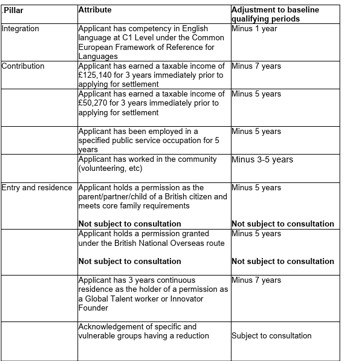
The following considerations will increase the baseline period:
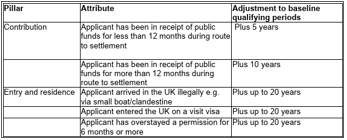
The other proposed changes are:
- The qualifying period for settlement of adult dependents of economic migrants will be separately determined based on their own attributes and circumstances.
- Minor children of economic migrants will be eligible to be granted settlement in line with their parents.
- A cut-off point linked to the age of dependent children may be introduced to transition to an immigration pathway and progress to settlement in their own rights.
- The Long Residence route will be scrapped.
- An increase in the baseline qualifying period to 15 years for those in the Skilled Worker route in a role below RQF level 6 (equivalent to a bachelor’s degree).
To reiterate, the above is subject to a consultation, and anyone who is interested should take part: https://ukhomeoffice.qualtrics.com/jfe/form/SV_1yMmiaG7zqwPuM6
This article is provided for general information only. It is not intended to be and cannot be relied upon as legal advice or otherwise. If you would like to discuss any of the matters covered in this article, please contact us using the contact form or email us on reception@cnsolicitors.com