
Earned settlement – what we know so far?
The UK Government’s intention to introduce changes to the standard qualifying period for permanent residence (also known as indefinite leave to remain or settlement) was first heard of in the 12th of May 2025’s White Paper.
On the 20th November 2025, the Home Office published a statement and accompanying consultation on earned settlement, which shed light on what the new earned settlement rules may look like. The consultation is now open until 11.59 pm on the 12th of February 2026, and the changes are expected to start being implemented in the April 2026 Statement of Changes.
Most welcome news is that the spouses and dependents of British Citizens and British Nationals (Overseas) Citizens on Hong Kong route will be unaffected by the proposed changes. Note that parents in the ten-year route may still be caught by the reform. The other unaffected groups are those under the EU Settlement Scheme, Windrush Scheme and HM Armed Forces.
The most distressing news is that there may be no transitional arrangements for those currently in the UK on a route to settlement. Those who may be affected by the reform should participate in the consultation (link is below) and “strongly disagree” with the question To what extent do you agree or disagree that there should not be transitional arrangements for those already on a pathway to settlement?
The gist of the change is to grant settlement on the basis of contribution to the UK rather than after a fixed period. Earned settlement is to be based on a “time adjustment” model built on four core pillars: character, integration, contribution and residence.
The default qualifying period (also called the baseline) will be 10 years, with the exception of certain groups or individuals and 20 years for those recognised as refugees. There will be three mandatory requirements when applying for settlement, namely:
Suitability:
- Requirements in Part Suitability must be met
- No current litigation, NHS, tax or other government debt
Integration:
- English Language Requirement – level B2
- Life in the UK test
Contribution:
Annual earnings above £12,570 for a minimum of 3 to 5 years, in line with the current thresholds for paying income tax and National Insurance Contributions (NICs), or an alternative amount of income
If the mandatory requirements are met, considerations will be given to the baseline period, which can be adjusted upwards or downwards.
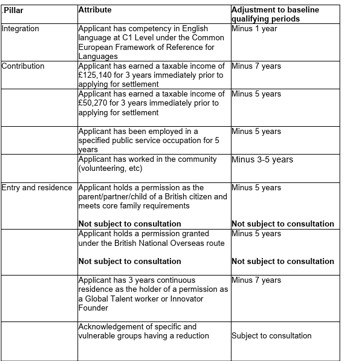
The table below sets out the proposed considerations that will reduce the baseline period:
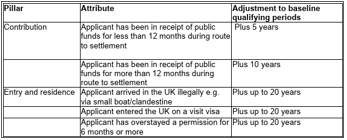
The following considerations will increase the baseline period:
The other proposed changes are:
- The qualifying period for settlement of adult dependents of economic migrants will be separately determined based on their own attributes and circumstances.
- Minor children of economic migrants will be eligible to be granted settlement in line with their parents.
- A cut-off point linked to the age of dependent children may be introduced to transition to an immigration pathway and progress to settlement in their own rights.
- The Long Residence route will be scrapped.
- An increase in the baseline qualifying period to 15 years for those in the Skilled Worker route in a role below RQF level 6 (equivalent to a bachelor’s degree).
To reiterate, the above is subject to a consultation, and anyone who is interested should take part: https://ukhomeoffice.qualtrics.com/jfe/form/SV_1yMmiaG7zqwPuM6
This article is provided for general information only. It is not intended to be and cannot be relied upon as legal advice or otherwise. If you would like to discuss any of the matters covered in this article, please contact us using the contact form or email us on reception@cnsolicitors.com