
Allotment and Share Transfer: What are the Differences?
Welcome to our Corporate & Commercial Explained series, where we explore key terms and concepts in corporate and commercial law and provide practical insights for businesses, shareholders and investors.
Shares in a company can change in a number of ways during the life of a business. A company may allot new shares to raise capital or bring in a new investor, or an existing shareholder may transfer their shares to somebody else.
Although allotment and transfer both involve changes to a company’s shareholding structure, they are different processes and can have different effects on the company and its shareholders.
What is an allotment of shares?
An allotment is where a company allots new shares to an existing or new shareholder, usually in return for payment or other consideration. The person receiving the shares becomes a shareholder once they are entered in the company’s register of members.
The key feature of an allotment is that new shares come into existence. The consideration is paid to the company, so an allotment is commonly used to raise equity finance. Once shares are allotted, the total number of shares in the company increases, and the company must notify Companies House.
An allotment can also affect the percentage ownership of existing shareholders. Where new shares are allotted to another person and an existing shareholder does not receive a proportionate number, their percentage shareholding will fall even though the number of shares they hold has not changed. This is commonly referred to as dilution, and it can affect a shareholder’s voting power and level of control.
Before allotting shares, a company will need to consider its articles of association, any shareholders’ agreement, whether the directors have the necessary authority to allot shares under the Companies Act 2006, and whether existing shareholders have statutory pre-emption rights. Statutory pre-emption rights generally apply where equity securities are allotted for cash, giving existing shareholders the opportunity to subscribe for the new securities in proportion to their existing holdings. They can be excluded by a private company’s articles or disapplied by shareholder resolution, so it is important to check what applies to the company in question.
What is a transfer of shares?
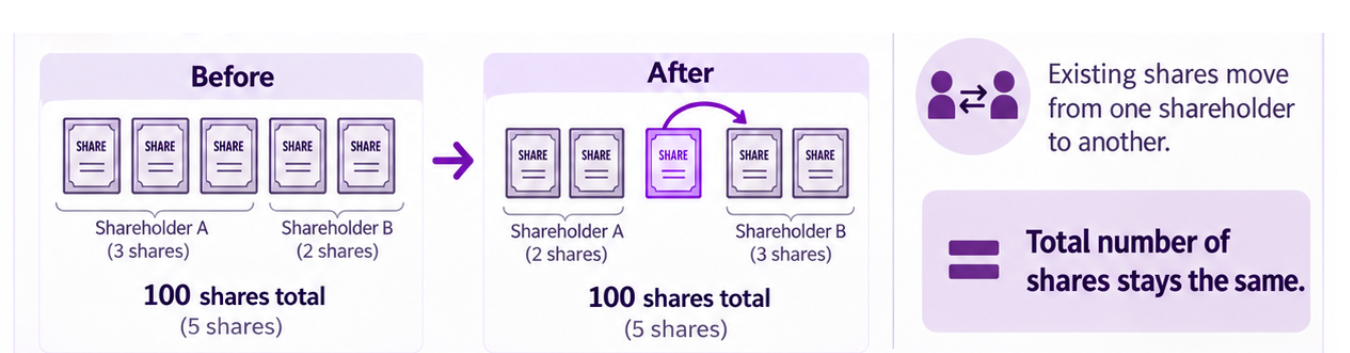
A share transfer occurs when an existing shareholder sells or gives some or all of their shares to another person, who may already be a shareholder or may become one as a result.
Unlike an allotment, no new shares come into existence, and the total number of shares stays the same. Where shares are sold, the price is paid to the transferring shareholder rather than to the company.
A transfer is usually effected by a stock transfer form, and the company must register the transfer (or give notice of refusal) within two months of receiving it. The articles and any shareholders’ agreement should also be checked before a transfer, as they may restrict transfers or give existing shareholders a right of first refusal.
Although the total number of shares does not change, a transfer can have a significant effect on ownership and control. For example, one shareholder may increase their percentage by acquiring shares from another.

What is the main difference?
The simplest way to distinguish the two is to consider what is happening to the shares. With an allotment, the company allots new shares and the total number increases. With a transfer, existing shares move from one holder to another and the total remains the same.
Either process can affect ownership structure, percentage interests and the balance of voting control. In both cases, changes in a person’s shareholding or voting rights may require the company’s PSC register and Companies House filings to be updated, particularly where the change takes the person above or below the more than 25% threshold.
How can we help?
The appropriate process will depend on the circumstances of the company and its shareholders. Companies should consider their articles of association, any shareholders’ agreement and the requirements of the Companies Act 2006 before making changes to their share structure. Please contact us to discuss your situation.
This article is for general information only and does not constitute legal advice. Specific advice should be sought before taking any action.
Coming next: Can a company buy back its own shares, and what are the effects of a share buy-back?
